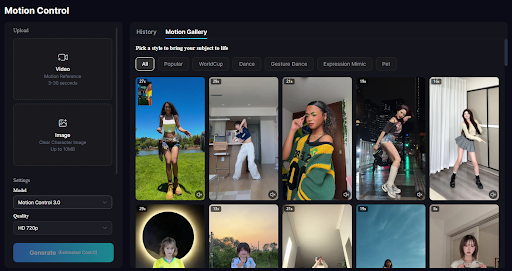
Artificial intelligence is rapidly changing the world of digital content creation, and one of the newest innovations in this space is Kling Motion Control. It is a powerful AI feature designed to generate and control motion in videos, allowing users to create cinematic scenes, animations, and realistic movements from simple prompts or images.
This technology is especially useful for filmmakers, content creators, advertisers, and designers who want to produce high-quality video content without expensive equipment or advanced editing skills.
What Is Kling Motion Control?
Kling Motion Control is an AI-driven system that allows users to guide and manipulate motion in generated videos. Instead of manually animating every frame, users can provide instructions or reference images, and the AI automatically creates smooth and realistic movement.
It is part of advanced text-to-video and image-to-video generation systems that use deep learning models to understand physics, motion, and visual consistency.
In simple terms, Kling Motion Control helps users turn static images or text prompts into moving video scenes.
How Kling Motion Control Works
The system uses powerful AI models trained on large video datasets. These models learn how objects move in real life, including:
- Human motion
- Camera movement
- Environmental effects (wind, water, lighting)
- Object interaction
When a user provides input, the AI follows these steps:
1. Input Understanding
The system reads the text prompt or image reference and identifies key elements.
2. Motion Planning
The AI decides how objects should move based on real-world physics and cinematic rules.
3. Frame Generation
It generates multiple frames that simulate smooth motion.
4. Video Rendering
Finally, all frames are combined into a high-quality animated video.
Key Features of Kling Motion Control
1. Text-to-Motion Generation
Users can describe a scene like:
“A robot walking through a futuristic city at night.”
The AI generates a moving video based on this description.
2. Image-to-Video Animation
Static images can be turned into dynamic videos with natural motion effects.
3. Camera Control
Users can control camera angles such as zoom, pan, and tracking shots.
4. Realistic Motion Physics
Movements are generated with realistic behavior, making animations feel natural.
5. Cinematic Quality Output
The system produces high-resolution video suitable for creative projects.
Uses of Kling Motion Control
Content Creation
YouTubers and social media creators use it to produce engaging videos quickly.
Film and Animation
Filmmakers can create concept scenes and pre-visualizations.
Advertising
Marketers generate promotional videos without expensive production setups.
Game Development
Developers use it for character animation and environment previews.
Education and Training
Teachers and trainers can create visual demonstrations and simulations.
Benefits of Kling Motion Control
Saves Time
Traditional animation takes hours or days, but AI generates motion in minutes.
Cost Effective
No need for large production teams or expensive software.
Easy to Use
Users only need to provide text or images—no animation skills required.
Creative Freedom
Allows users to experiment with ideas that would be difficult to animate manually.
High Quality Output
Produces smooth, realistic motion suitable for professional use.
Motion Control AI: The Future of Intelligent Video and Animation
Artificial intelligence is transforming digital media at a rapid pace, and one of the most powerful innovations in this field is motion control AI. This technology allows users to generate, guide, and manipulate movement in videos, animations, and digital scenes using simple text prompts, images, or control signals.
Motion control AI is becoming a key tool for filmmakers, game developers, designers, and content creators who want to produce high-quality motion graphics without traditional animation skills.
What Is Motion Control AI?
Motion control AI refers to artificial intelligence systems that can create or manage movement in digital content. Instead of manually animating objects frame by frame, AI automatically generates motion based on user input.
This input can include:
- Text descriptions
- Reference images
- Motion paths
- Camera instructions
- Depth or pose data
The AI then interprets this information and produces smooth, realistic motion.
How Motion Control AI Works
Motion control AI is built on advanced machine learning models trained on large video datasets. These models learn how objects move in real life, including human motion, environmental effects, and camera dynamics.
The process generally works in four stages:
1. Input Analysis
The system reads the prompt or reference image and identifies objects, characters, and desired motion.
2. Motion Planning
The AI determines how each element should move over time, including speed, direction, and interaction.
3. Frame Generation
Multiple frames are created to simulate continuous motion.
4. Video Rendering
All frames are combined into a smooth, coherent video output.
Challenges and Limitations
Despite its power, motion control AI still has some limitations:
- Complex scenes may produce unnatural motion
- Fine interactions between objects can be inaccurate
- Fast or chaotic movement may cause visual artifacts
- Rendering high-quality videos can require significant computing power
However, these issues are improving as AI models evolve.
Future of Motion Control AI
The future of motion control AI is extremely promising. As technology advances, we can expect:
- Fully AI-generated movies
- Real-time motion editing tools
- Voice-controlled animation systems
- Hyper-realistic character movement
- Integration with VR and AR environments
Eventually, users may be able to create entire films by simply describing scenes in natural language.
Conclusion
Motion control AI represents a major breakthrough in digital creativity. It allows users to generate realistic movement and cinematic video content without traditional animation skills.
From entertainment and gaming to marketing and education, this technology is reshaping how motion is created and controlled. As AI continues to improve, motion control systems will become even more powerful, accessible, and essential for modern content creation.